
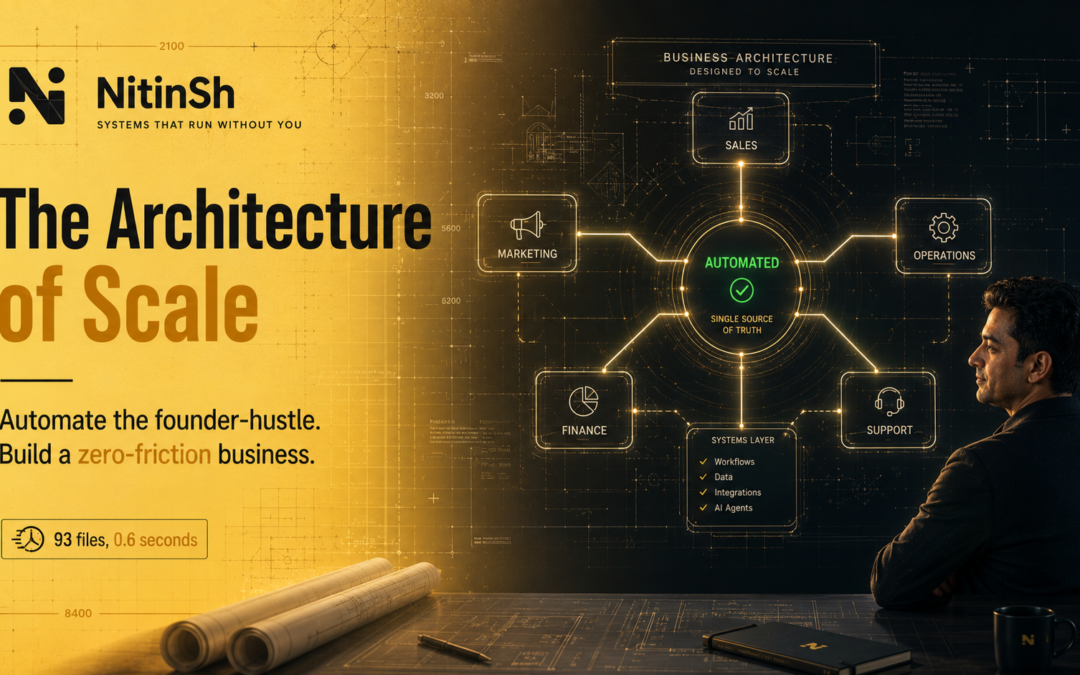
Learning how to automate business processes with AI is becoming one of the biggest competitive advantages for founders. Yet most businesses still depend on manual work.
As a founder, your most dangerous enemy is not the competition. It is not the market. It is not even your cash flow.
It is Manual Debt.
Manual Debt is the accumulation of every “quick” task you do yourself because it is just easier that way. It is the two hours you spend sorting files, the three hours you spend scraping leads, and the four hours you spend cleaning up your CRM.
We call it hustle. In reality it is a ceiling. You cannot scale a business that depends on the manual effort of its founder.
As an AI automation consultant for small business in Delhi NCR, recently I ran a live experiment to prove it. I had a library of 93 high-level AI research articles as PDFs from Substack. They were disorganized, chaotic, and functionally useless in that state. I had two choices: spend an afternoon as a file clerk, or spend ten minutes as an architect.
I chose the architect. Using a simple Python script and a logic-first mindset, I sorted all 93 files into strategic categories in 0.6 seconds.
But this post is not about sorting PDFs. It is about the architecture of scale: how you take that same logic and apply it to your sales, marketing, operations, and personal brand to reclaim the hours you are losing every week.
1. The Matrix Realization: Everything Is Logic
The first step to a zero-friction business is a mindset shift I call the Matrix Realization.
Most founders see their business as a series of tasks. An architect sees it as a series of logic chains.
When you look at a messy folder, do not see work. See a pattern.
- The pattern: this file contains the word “Agent.”
- The rule: if the pattern is “Agent,” then move it to Folder A.
This is the foundation of practical AI.
AI is not a magic box that thinks for you. It is a high-speed execution engine for the logic you give it. Whether you are sorting a PDF, spotting a high-value lead, or prioritizing support tickets, the process is the same: identify the pattern, write the rule, automate the action.
2. Hiring Your Digital Workforce (Without the Payroll)
When you automate, you are not just using tools. You are hiring a digital workforce that costs cents, never sleeps, and does not make the tired-at-4pm mistakes a human does.
Here are the three personas you can hire today.
The Digital Intern (web scraping and research)
In my marketing and startup background, I have watched founders spend ten hours a week just staying informed. They scroll, they read news sites, they check competitor blogs.
The automated version: you build a Digital Intern. This script visits your target sources every morning, finds the headlines that match your niche, uses an LLM to summarize them into three bullet points, and sends them to your WhatsApp.
The return: you reclaim the hours you spent staying informed, and the task cost drops toward zero while your awareness stays high.
The Super-Powered Accountant (data and spreadsheet automation)
Small businesses are often data rich but insight poor. They have payment reports, bank statements, and ad-spend sheets, but they do not know their real-time numbers because the data lives in three different formats.
The automated version: a Python engine that talks to your spreadsheets. It reconciles invoices, flags discrepancies, and updates a master dashboard automatically.
The return: you move from monthly accounting to real-time intelligence. You decide on today’s data, not last month’s.
The Visionary Sorter (computer vision)
If your business runs on visual assets, real estate, e-commerce, or content, you know the pain of the photo dump.
The automated version: computer-vision models that look at each image, tell a modern living room from a classic kitchen, and tag them for your team.
The return: your marketing team goes from searching for assets to launching campaigns.
3. The I.I.I. Framework for Strategic Automation
If you are stuck in the manual trap, you do not need a six-month transformation. You need three steps.
I. Identify the Friction
Look at your last seven days. Highlight every task that was repetitive, digital, and required zero creative input. If you did it more than three times, it is a candidate for automation.
II. Isolate the Logic
Can you explain the task to a ten-year-old?
- “Go to this website, find the email address, put it in this sheet.”
- “Look at this invoice, if the total is over a set amount, flag it.”
If you can isolate the logic, a script can execute it.
III. Implement the Script
This is where most people stop, because they are not coders. But as my pdf file experiment showed, the code is the easy part. The system design is the hard part. With the Terminal and simple Python, you can build these bots in minutes.
Here is the beginner version of the exact script I used, so you can feel it work:
# Paste this into your Mac Terminal
cat << 'EOF' > organizer.py
import os, shutil
RULES = {"Research": ["ai", "agent", "llm"], "Finance": ["invoice", "report"]}
def run():
    for f in [f for f in os.listdir('.') if f.endswith('.pdf')]:
        for folder, keys in RULES.items():
            if any(k in f.lower() for k in keys):
                if not os.path.exists(folder): os.makedirs(folder)
                shutil.move(f, os.path.join(folder, f))
                print(f"Moved {f} to {folder}")
if __name__ == "__main__": run()
EOF
python3 organizer.py
4. Why Off-the-Shelf Is Not Enough – How to Automate Business Processes with AI
Many founders try to solve this with generic tools like Zapier or IFTTT. They are fine for simple tasks, but they become a spaghetti mess of connections that break easily.
To build something that lasts, you need custom-built automation, and often an n8n or Python system rather than a chain of third-party triggers.
- Generic tools cannot handle the nuance of your specific data.
- Generic tools cannot read your specific brand voice.
- Generic tools cost more as you scale.
Custom automation, like the script that sorted the pdf of articles, is near-zero marginal cost.
Once it is built, it belongs to you. It runs on your machine. It scales with you. This is the difference between renting a workaround and owning a system, and it is the core of what an AI automation consultant actually builds for you.
5. The Ladder of Solutions
There are three rungs to solving any friction, and knowing which one you need is half the battle.
- Tier 1, Manual: a human does the task every time. Linear cost, zero scale.
- Tier 2, Scripted: a keyword-level script clears the repetitive work at near-zero cost. High leverage, limited to surface data.
- Tier 3, Strategic API and Human: a custom integration where the AI reads context and understands nuance, with a human checking the edges where judgment matters.
Keeping a human in the loop at Tier 3 is what makes the system both autonomous and aligned with your goals. This is the custom architecture I build, taking a business from Tier 1 to Tier 3 in a single leap.
6. From Personal Brand to Enterprise Power
If you are building a personal brand, your scarcity of time is your biggest bottleneck. You should be creating, speaking, and networking. You should not be sorting files.
Picture your brand when your research runs itself, your lead generation is a background process, and your operations self-heal. You do not just look like an expert. You have the bandwidth of one.
Conclusion: Will You Be the Intern or the Architect?
The pdf files experiment was a small win, but it points to a large truth: the technology to handle your boring work already sits on your laptop, waiting for the right command.
You can keep hustling through manual tasks, or you can decide today to stop being an intern in your own company.
I’m Nitin Sharma, an AI automation consultant with 19 years of experience in marketing and sales and the founder of three ventures. I specialize in finding these logic chains and turning them into automated engines, for SMB founders across Delhi NCR and beyond. Whether it is 15 PDFs or 15,000 customer records, the goal is the same: more scale at far less friction.
If you are ready to audit your manual processes and reclaim your time, book a free AI audit and I will show you where your first automation should go…welcome aboard to a world of freedom from manual work.